Tolkien - History Meets Legend
Nancy Bunting
Cormarë Series No. 56

<--previous | all publications | next-->
how to buy this item
 "Legend and History have met and fused" (OFS 156)
These essays deal with how Tolkien excavated the mother lode of his own history to create legends. This strategy can be seen in his use of S.R. Crockett's The Black Douglas and his late essay, "Aldarion and Erendis." This biographical approach appears at the start of The Lord of the Rings in the Bombadil chapters, and in his intimate portrait of Faramir, the character whom Tolkien wrote is "like me."
The main essay reviews the inferred traumatic events of March 1904, when food and water ran low and the isolated, housebound Mabel Tolkien was challenged by caring for two sick boys. Already in the late stages of diabetes, Mabel Tolkien faced only three possible medical outcomes: death, coma, or psychosis. In March 1904, the first two did not occur. The logically reconstructed events of March 1904 aim to reveal Tolkien's own History which "resembles 'Myth', because they are both ultimately of the same stuff ." Tolkien's story finds its eucatastrophe in "the sudden miraculous experience of Fr. Francis love and care and humour" which allowed an escape from "hunger, thirst, poverty, pain, sorrow, injustice, death," all parts of the trauma of 1904.
By grounding the reading of Tolkien's writings, artwork, and maps in his biography, these detailed essays provide unique insights into his creations. As Tolkien said: "I hold the key."
table of contents | cover | announcements | more
Acknowledgments
Series Editor’s Preface
Introduction
"Aldarion and Erendis" as an Imagined History of Tolkien's Early Life
Giving Credit Where Credit Is Due: S.R. Crockett's The Black Douglas
Faramir and Tolkien, in War and Courtship
Tolkien's 1904 Trauma and its Exorcism
- I Tolkien and Trauma
- II The Topography of Suffering
- III Tolkien and Spiders
- IV Conclusion
Past is Prologue: The Bombadil Chapters in The Lord of the Rings
List of Bibliographic Abbreviations
Bibliography
List of Illustrations
About the Author
Index
table of contents | cover | announcements | more
Cover
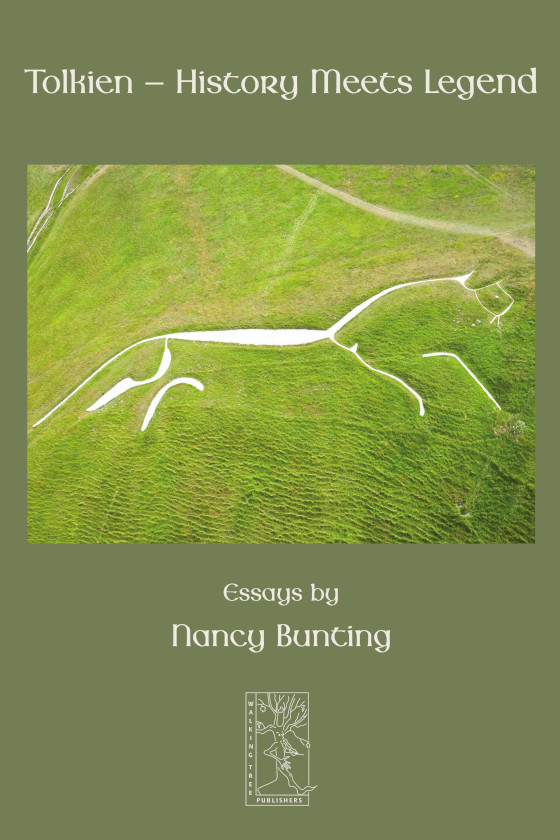
The image on the cover is the Uffington White Horse, the oldest chalk figure in Britain, created between 1380 BC and 550 BC. J.R.R. Tolkien had a deep appreciation of this figure, its history and mythic meaning (Garth, Worlds of Tolkien 145). The seventeenth-century antiquary John Aubry believed that: "The white horse [Uffington] was made by Hengist, who bore one on his arms or standard" (Howey 71).
Cover: Foto 'Aerial view to Uffington White Horse' by Valerie 2000,
AdobeStock_601963690
Cover-design by Stefan Honegger
table of contents | cover | announcements | more
Announcements
Tolkien - History Meets Legend (28th June 2026)
344 pages, Walking Tree Publishers 2026, Cormarë Series No. 56, ISBN: 978-3-905703-56-6.
<--previous | all publications | next-->
how to buy this item

More on Tolkien - History Meets Legend
terms and conditions
visitors since
last updated